
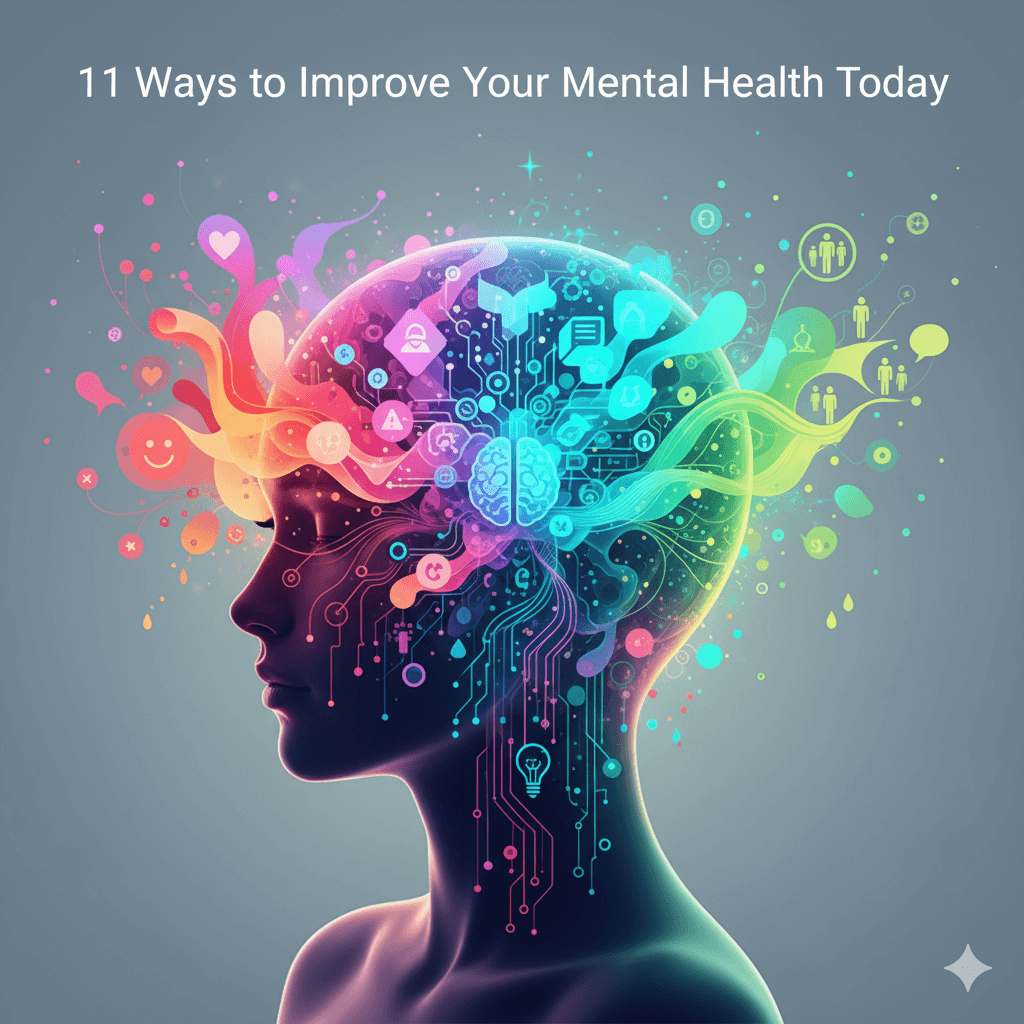

Mental health encompasses your emotional, psychological, and social well-being – it’s more than just the absence of mental illness. Good mental health helps you cope with stress, enjoy life, and build fulfilling relationships. In fact, about 1 in 5 U.S. adults experiences a mental illness each year, so strengthening mental health is a universal concern. By proactively practicing healthy habits, you can boost your mood and resilience. Below are 11 evidence-based strategies to improve your mental well-being, drawn from expert sources and research.
1. Be Kind to Yourself (Self-Compassion)

Many people slip into harsh self-criticism when stressed or upset. Instead, treat yourself as you would a good friend. Research shows self-compassion – offering yourself warmth and understanding – can reduce anxiety and depression. Harvard Health notes “self-compassion offers several benefits to mental…health,” helping you bounce back from challengeshealth.harvard.edu. Neuroscientists find that compassionate self-talk engages brain areas linked to soothing and reduces stress responses.
-
Shift your self-talk. When you notice negative thoughts (“I should have done better”), pause and reframe them as if addressing a friend (“Anyone could make that mistake, I’m doing the best I can”).
-
Comfort your body. Gently place a hand on your heart or give yourself a hug when you feel down. This physical reminder of care can trigger self-soothing neural circuits.
-
Write a supportive note. Imagine what advice you’d give a friend in your situation, and write that encouragement to yourself.
By consistently practicing self-kindness, you build resilience. Over time, self-compassion acts like emotional muscle memory – the more you do it, the more naturally you’ll react kindly to yourself during setbackshealth.harvard.educcare.stanford.edu.
2. Practice Mindfulness
Regular mindfulness or meditation (as shown above) activates the relaxation response and helps clear the mind. Research indicates mindfulness training significantly reduces stress, anxiety, and depression compared to no interventioncam.ac.uk. For instance, a 2024 study of over 1,200 adults found that just 10 minutes of daily mindfulness practice led to a ~19% drop in depression and a ~13% drop in anxiety scores over one month, compared to controlssouthampton.ac.uk. Mindfulness teaches you to focus on the present moment – your breathing, sensations, or surroundings – which interrupts the habitual cycle of ruminating on past worries or future fearsnews.harvard.edu. Over time, this increased awareness strengthens your emotional regulation and inner calm.
-
Short daily practice: Start with just a few minutes of guided breathing or body scanning each morning or evening. Even brief, consistent sessions (5–10 minutes) build a habit.
-
Mindful activities: Bring awareness to routine tasks – wash dishes or drink your morning coffee slowly, noticing smells, textures and tastes. This anchors you in the now and can make mundane tasks a form of meditation.
-
Focus on breaths: If anxious thoughts arise, pause and breathe slowly from your diaphragm (inhale for 4 seconds, exhale for 6). Research shows this parasympathetic breathing rapidly lowers heart rate and stresshealth.harvard.edu.
Scientific reviews confirm the benefits: an international analysis found mindfulness programs significantly improve well-being and decrease stress compared to doing nothingcam.ac.uk. Mindfulness isn’t about “stopping thoughts” altogether, but observing them without judgment. As Zen masters note, being fully present with a task (even washing dishes) can transform it into a pleasant, mindful experiencenews.harvard.edu. With regular practice, mindfulness becomes a tool you can use anytime to steady your emotions and mind.
3. Use Relaxation Techniques
Relaxation techniques intentionally trigger the body’s relaxation response: lowered breathing, reduced muscle tension, and a calmer mind. A lab study confirms that progressive muscle relaxation (PMR), guided imagery, and deep breathing each significantly increase relaxation and reduce stress compared to doing nothingpmc.ncbi.nlm.nih.gov. For example, slowly tensing and releasing muscle groups (from toes up to head) eases bodily tension and releases mental stress. Similarly, vividly imagining a tranquil scene (a quiet beach or forest) can distract the mind from anxiety, lowering stress hormones immediatelypmc.ncbi.nlm.nih.gov.
-
Progressive muscle relaxation: Lying or sitting comfortably, tense one muscle group (e.g. feet) for 5–10 seconds, then release. Notice the contrast between tension and relaxation. Move systematically through your body. This technique reliably reduces psychological and physiological stresspmc.ncbi.nlm.nih.gov.
-
Guided imagery: Close your eyes and picture a calming place (forest, mountains, ocean). Engage all senses: feel the breeze, hear gentle waves or birdsong. Studies show guided imagery can induce deep relaxation, improving mood and lowering anxietypmc.ncbi.nlm.nih.gov.
-
Yoga and movement: Gentle yoga combines breathwork and stretching to ease both body and mind. Harvard Health highlights that yoga’s coordinated breathing and movement significantly reduce anxiety and depressionhealth.harvard.edu. In fact, a review in Aging & Mental Health found yoga to be one of the most effective relaxation practices for reducing mental distress, often with longer-lasting effects than other methodshealth.harvard.edu.
-
Deep breathing: Practice inhaling slowly to a count of 4, holding for 4, and exhaling to 4 (“box breathing”). This technique activates the parasympathetic nervous system, producing a calm state. Even a few deep breaths can quickly lower heart rate and clear the mindhealth.harvard.edu.
Each of these techniques is free and portable – you can do them almost anywhere. Over time, you’ll build “stress immunity,” meaning you can quickly shift to a relaxed state when facing daily pressures.
4. Spend Time in Nature
Even short walks in natural settings have measurable mental health benefits. Spending time in green spaces – sometimes called “forest bathing” – has been scientifically linked to lower stress and better mood. For example, one study comparing equal-length walks found that in a forest setting (vs. a city street) people’s cortisol (stress hormone) levels dropped by about 12%, and their blood pressure and heart rate decreased substantiallypsychiatry.org. Time outdoors also improved immune function. Importantly, nature exposure reliably improves mood and reduces symptoms of anxiety and depression: a University of Michigan study found that even a brief nature walk significantly lifted mood in people with depressionpsychiatry.org.
-
Take daily green breaks: Aim for at least 10–20 minutes outside each day – a stroll in a park, a moment sitting under a tree, or even time on a balcony with plants.
-
Engage your senses: Notice the colors, sounds, and smells around you (rustling leaves, birdsong, fresh air). This sensory immersion enhances the calming effect.
-
Find your natural dose: If forests aren’t accessible, any natural element helps: watch clouds, enjoy a sunset, walk barefoot on grass, or care for a garden. These simple acts are forms of nature therapy.
Incorporating nature into your routine – even city greenery or a houseplant – can steadily replenish your emotional well-being, making you more resilient to life’s stressespsychiatry.orgpsychiatry.org.
5. Get Enough Sleep
Sleep is a cornerstone of mental health. Experts recommend 7–9 hours of sleep per night for adultspmc.ncbi.nlm.nih.govcolumbiapsychiatry.org. Consistently getting less than 7 hours is linked to a higher risk of depression, anxiety, and other health problemspmc.ncbi.nlm.nih.gov. For example, Stanford researchers report that people with insomnia are 10 times more likely to develop depression and 17 times more likely to develop anxiety than those without sleep problemsmed.stanford.edu. Conversely, improving sleep often improves mood: studies show that when people with insomnia use therapy or better sleep habits, their depressive symptoms declinemed.stanford.edu.
-
Maintain a sleep schedule: Go to bed and wake up at the same times daily (yes, even weekends). Consistency helps regulate your body clock.
-
Create a wind-down routine: An hour before bed, limit screens and bright lights. Instead, read, take a warm shower, or do gentle stretches to signal your body it’s time to relax.
-
Optimize your sleep environment: Keep your room dark, cool, and quiet. Reserve your bed for sleep and intimacy only (no work or TV).
-
Address sleep issues: If you struggle with chronic insomnia or non-restorative sleep, consider therapies like cognitive-behavioral therapy for insomnia (CBT-I), which research shows can improve both sleep and moodmed.stanford.edu.
Prioritizing sleep has immediate payoffs: a well-rested brain is better at handling stress, solving problems, and regulating emotions. Even losing an hour of sleep can noticeably erode your mood and focus the next daypmc.ncbi.nlm.nih.gov, so protecting your sleep is one of the fastest ways to boost mental health.
6. Pick Up Your Journal (Writing Therapy)
Writing about your thoughts and feelings is a powerful mental health tool. Decades of research on expressive writing show that journaling about stressful or emotional events leads to significant improvements in mental (and even physical) healthcambridge.org. In Pennebaker’s classic studies, students who wrote about trauma for just 15–20 minutes per day reported fewer health visits and lower stress months later, compared to those writing about neutral topicscambridge.org.
-
Free-write 10–15 minutes: Pick a private, quiet time a few days a week to write in a journal. Don’t worry about grammar or style – just let your thoughts flow. You may start on one topic and find yourself moving to another; that’s fine.
-
Record feelings and triggers: Writing helps you externalize worries. Jot down anxiety or stresses, and you’ll often notice patterns or triggers emerge. Recognizing these can help you address them more effectively.
-
Try gratitude journaling: Occasionally, write what went well that day or things you appreciate. Research links gratitude journaling to higher happiness and reduced depression (see next tip).
-
Use it constructively: If you write about a problem, take a moment afterward to brainstorm one potential solution or coping strategy. This frames journaling as not just venting, but also planning.
Medical sources confirm journaling’s benefits: the University of Rochester Medical Center notes journaling can “manage anxiety, reduce stress, [and] cope with depression” by organizing your thoughts and encouraging positive self-talkurmc.rochester.edu. Even short, regular writing sessions create a personal space to process emotions, turning vague worries into concrete words you can examine and learn from.
7. Exercise Regularly
Physical activity is a potent mood lifter. The World Health Organization explicitly states that regular exercise reduces symptoms of depression and anxiety and enhances brain healthwho.int. On a chemical level, exercise increases the release of endorphins and neurotransmitters (like serotonin and dopamine) that improve your moodpmc.ncbi.nlm.nih.gov, while lowering stress hormones such as cortisol. Even a single workout can have immediate benefits: the CDC notes that moderate exercise can quickly reduce anxiety and boost mood and mental performancecdc.gov.
-
Aim for consistency: Strive for about 150 minutes of moderate activity per week (e.g. 30 minutes/day, 5 days a week). This could be brisk walking, cycling, swimming, dancing, or any movement you enjoy.
-
Start small: If you’re new to exercise, begin with 10-minute walks or short home workouts. Gradually increase duration/intensity. Every bit counts – even light activity breaks up sedentary time and adds up over the day.
-
Include what you like: Enjoyment is key for sticking with exercise. Listen to music or podcasts, explore a new outdoor trail, or work out with a friend. If you have fun, you’ll look forward to it.
-
Variety and strength: Mix cardio (walk, run, bike) with strength or yoga to benefit body and mind in different ways. Exercise also improves sleep, which further supports mental healthpmc.ncbi.nlm.nih.gov.
Numerous studies confirm that those who exercise regularly have lower rates of depression and anxiety than sedentary peoplewho.int. Importantly, you don’t have to overdo it: moderate, routine activity has been shown to improve well-being as effectively as some medications in mild-to-moderate depression cases. Over time, exercise builds energy, confidence, and a positive feedback loop (feeling better makes you more active, and vice versa)pmc.ncbi.nlm.nih.gov.
8. Nurture Your Relationships
Humans are social creatures, and quality connections are vital for mental health. Research shows that people who are more socially connected – with friends, family, or community – are happier and physically healthier, with fewer mental health problems than those who are isolatedmentalhealth.org.uk. It’s not the quantity but the quality: supportive, positive relationships (and even casual kindness from others) create a buffer against stress. For example, strong friendships or a happy marriage are linked to lower stress and depressionmentalhealth.org.uk, whereas conflictual or toxic relationships raise the risk of anxiety, depression, and lonelinessmentalhealth.org.uk.
-
Reach out regularly: Schedule calls, video chats or meet-ups with people you care about. Even a quick text to check in can reinforce bonds.
-
Be honest about needs: If you’re feeling down or lonely, tell someone. You might say, “I’m going through a tough time and could really use a chat.” Most friends/family would welcome the chance to support you.
-
Join groups or volunteer: Participating in community activities (classes, clubs, volunteering) can expand your social circle and give you a sense of belonging. Helping others also releases oxytocin (“love hormone”) and boosts mood.
-
Practice kindness: Acts of kindness (holding the door, complimenting someone) not only help others but also give you positive feelings and strengthen your social network.
Even for introverts, periodic social interaction is crucial. Studies find that supportive social connections reduce symptoms of depression and boost resilience to stressmentalhealth.org.ukmentalhealth.org.uk. As one expert puts it, negative interactions with others can fuel mental illness, while positive connections greatly improve well-being. Prioritizing relationships – and repairing or letting go of unhealthy ones – is a powerful way to care for your mental health.
9. Practice Gratitude
Actively appreciating the good in your life shifts your mind toward positivity. Extensive research links gratitude to higher well-being and lower depression/anxiety. For instance, Harvard Health reports that gratitude practices enhance emotional and social well-being, improve sleep quality, and significantly reduce depression riskhealth.harvard.edu. Similarly, UCLA health experts note that people who routinely focus on positive aspects are less likely to feel anxious or depresseduclahealth.org. Gratitude exercises literally rewire the brain to notice positives – even on tough days you might remind yourself, “I’m grateful for this warm coffee” or “I appreciate a friendly coworker today.”
-
Keep a gratitude journal: Each evening, write down 2–3 things that went well or that you’re thankful for (no matter how small). Over time this trains your brain to seek out positives in daily life.
-
Share your thanks: Express gratitude to someone in your life. A thank-you note, text, or verbal appreciation can deepen your relationships and reinforce your own positive feelings.
-
Reframe negatives: When facing hardship, try to consciously note even one good thing. For example, “This was a hard week, but I’m grateful I have a comfortable bed to sleep in.” This doesn’t dismiss pain, but adds balance and hope.
Studies find that even short bursts of gratitude practice (e.g. 15 minutes of journaling, five days a week) produce lasting mental health gainsuclahealth.org. Over time, gratitude reduces stress hormones and cultivates a sense of abundance. In essence, gratitude is about catching your brain doing something positive – and reinforcing it.
10. Learn What Self-Care Means for You
Self-care is any intentional action you take to preserve or improve your health. According to experts, even small acts can have big impactsnimh.nih.gov. Self-care looks different for everyone. SNHU defines it broadly as anything that keeps you mentally, emotionally, physically, socially or spiritually healthysnhu.edu. It’s not selfish or frivolous; it’s like putting on your own oxygen mask first so you have something to give others. The key is creating space for what recharges you. For one person it might be taking a relaxing bath, for another it’s playing guitar or practicing yoga, for someone else it’s chatting with a close friend.
-
Identify your needs: Think about what makes you feel good and reduces stress. It could be hobbies (painting, cooking), movement (walking, dancing), relaxation (listening to music, meditating), or simple pleasures (coffee break, petting an animal).
-
Schedule self-care: Build it into your routine. For example, set aside 15–30 minutes daily for something you enjoy. Treat it as non-negotiable time for yourself.
-
Balance basic care: Remember that basic healthy habits are also self-care: eating nutritious meals, staying hydrated, exercising, and getting sleep are foundations that support your well-beingnimh.nih.gov.
-
Adapt when stressed: When you’re very busy or upset, even micro-self-care helps – a few deep breaths, standing up to stretch, or stepping outside for a moment.
Psychologists emphasize that self-care is not indulgence but preservation. Regular self-care replenishes your energy and emotional reserves, making you better able to cope with challenges. As NIMH notes, even minimal daily self-care “can have a big impact” on managing stress and boosting energynimh.nih.gov. In short, view self-care as essential, personalized maintenance for your mind and body.
11. Start Therapy (Professional Help)
Therapy isn’t just for crises – it’s a valuable tool for everyone’s toolkit. Evidence-based therapies are proven to work. One review of the research states that psychotherapies (like cognitive-behavioral therapy, interpersonal therapy, etc.) are “efficacious and cost-effective for a wide range of psychiatric conditions”pmc.ncbi.nlm.nih.gov. The American Psychiatric Association notes that about 75% of people who enter psychotherapy see some benefitpsychiatry.org. Therapy can teach you new coping skills, help you understand underlying issues, and provide a supportive space to explore feelings. It often leads to measurable improvements in brain function similar to those seen with medicationpsychiatry.org.
-
Consider the fit: There are many therapy types. For example, Cognitive-Behavioral Therapy (CBT) helps you identify and change unhelpful thinking patterns (very effective for depression and anxiety)psychiatry.org. Interpersonal Therapy (IPT) focuses on relationship issues, and other approaches address past trauma or emotional regulation. A good therapist will work with you to find the right approach.
-
Expect collaboration: Therapy is most effective when you actively engage. This might include reflecting on homework (journaling, practicing skills) between sessions.
-
Take the step: If you notice persistent feelings of hopelessness, overwhelming anxiety, or difficulty functioning, reaching out for therapy can provide relief. Even if you feel okay but just want personal growth, therapy can enhance your life satisfaction.
-
Online options: If in-person therapy is hard to access, many reputable online therapy services exist. They offer flexibility and can connect you with licensed therapists from home.
Therapy can literally change brain patterns underlying stress and mood. And because a therapist is an objective ally, talking through problems often helps you gain perspective you can’t find alone. Even a few sessions can empower you with strategies and a clearer sense of purpose. In sum, starting therapy is a proactive way to strengthen your mental health foundation.
Final Thoughts
Improving mental health is a gradual process, not an overnight fix. It’s normal for progress to be slow, especially when you’re feeling low. Experts advise starting with small, manageable steps. For example, just 10 minutes of daily mindfulness or a short gratitude journal entry can make a noticeable differencesouthampton.ac.ukuclahealth.org. Over weeks and months, these habits compound, building resilience.
Remember to be patient and celebrate little wins (woke up on time, took a walk, did a relaxation exercise). The goal is consistent self-care, not perfection. As one psychologist puts it, focusing on “slow and incremental changes” dramatically raises the chance of long-term success. If you can, end each day by noting one positive thing (no matter how small) – this simple habit helps reinforce hope and gratitude.
Finally, don’t hesitate to seek support when needed. Talk to trusted friends or family about how you feel. Consider professional help if stress or sadness becomes overwhelming. The combination of these strategies – kindness, mindfulness, social support, and possibly therapy – can transform your mental health over time. By integrating even a few of the above tips into your routine, you create a stronger foundation for joy, connection, and resilience in your lifesouthampton.ac.ukuclahealth.org.
Sources: Authoritative health and medical sources including Harvard Health, WHO, CDC, NIMH, and peer-reviewed studies have been cited to support these tips (see in-text references).